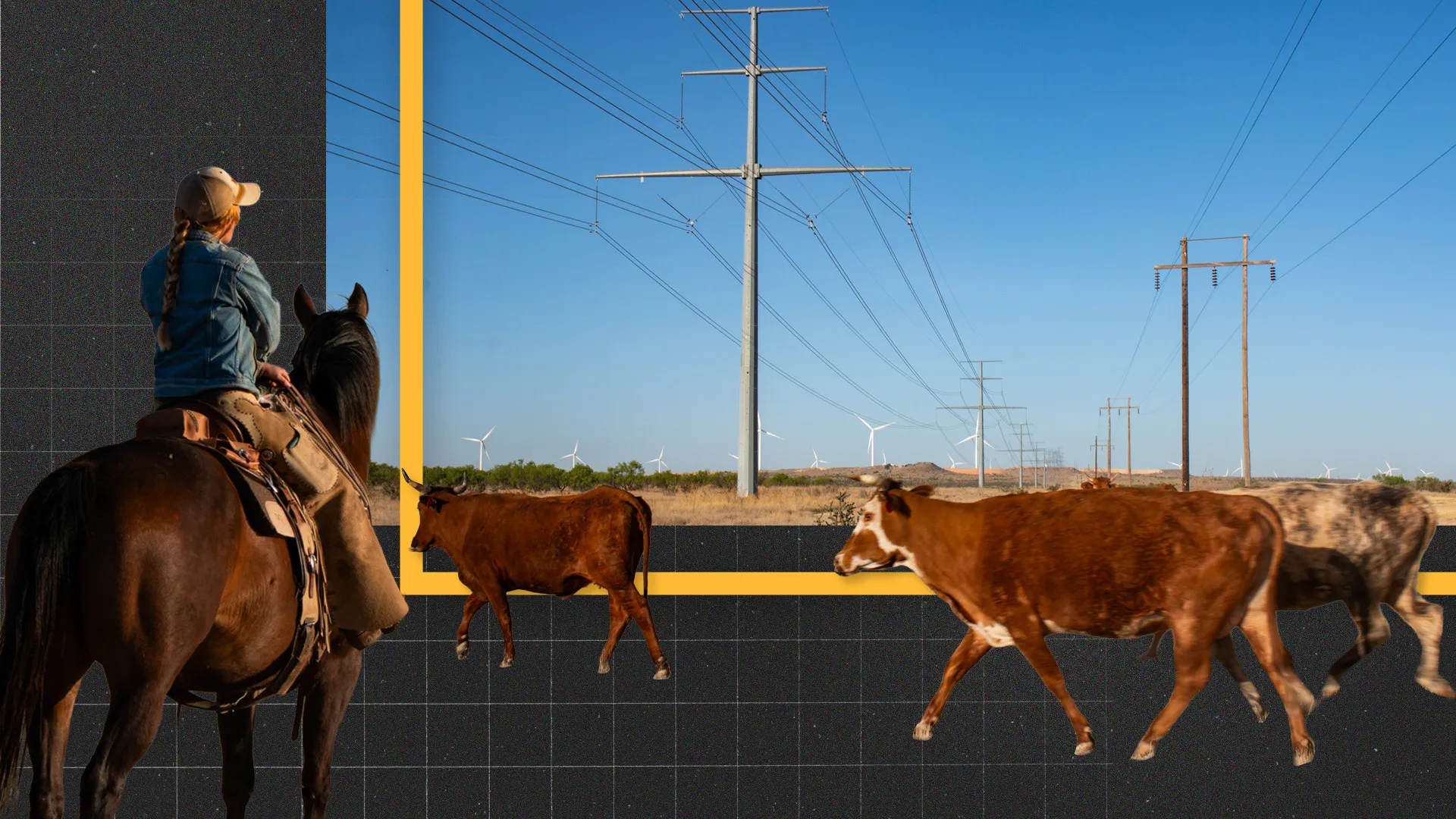
输电线路穿越牧场:德州石油与养牛业的冲突

!
The Global Privacy Signal that you have set in your device's browser has been recognized.
This website uses cookies
Through our own and third-party tracking technologies like cookies, pixels, and web beacons, we collect and share with third parties (including advertisers and social media networks) electronic network activity information and personal identifiers (including IP addresses and device identifiers) to allow the website to function, prevent fraud, store your preferences, analyze your usage of the website, personalize your experience, improve our services, measure ad performance, and offer you advertisements that target your particular interests based on your interactions. Our use of certain cookies may be considered a sale or sharing (or processing for targeted advertising) under US state data privacy laws. To opt out of such cookies, please click “Do not sell/share." Service provider trackers acting on our behalf, and not for their own purposes, will remain, as will essential trackers. If we have detected an opt-out preference signal (e.g. Global Privacy Control),then it will be honored. You must opt out separately on each device and browser. For additional information and the retention terms for the trackers, please see our Privacy Policy. Show details Hide details
Cookie declaration
Necessary (26)
Necessary cookies help make a website usable by enabling basic functions like page navigation and access to secure areas of the website. The website cannot function properly without these cookies.
Preferences (4)
Preference cookies enable a website to remember information that changes the way the website behaves or looks, like your preferred language or the region that you are in.
Statistics (20)
Statistic cookies help website owners to understand how visitors interact with websites by collecting and reporting information anonymously.
Marketing (64)
Marketing cookies are used to track visitors across websites. The intention is to display ads that are relevant and engaging for the individual user and thereby more valuable for publishers and third party advertisers.
Unclassified (0)
Unclassified cookies are cookies that we are in the process of classifying, together with the providers of individual cookies.
We do not use cookies of this type.
Cookie declaration last updated on 6/13/26 by Cookiebot (https://www.cookiebot.com/)
About
Cookies are small text files that can be used by websites to make a user's experience more efficient.
The law states that we can store cookies on your device if they are strictly necessary for the operation of this site. For all other types of cookies we need your permission.
This site uses different types of cookies. Some cookies are placed by third party services that appear on our pages.
You can at any time change or withdraw your consent from the Cookie Declaration on our website.
Learn more about who we are, how you can contact us and how we process personal data in our Privacy Policy.
Please state your consent ID and date when you contact us regarding your consent.
Accept Do not sell/share
Skip to content (https://san.com/cc/these-ranchers-heal-the-land-the-power-company-drew-a-line-through-it/#wp--skip-link--target)
Energy (https://san.com/energy/)
These ranchers heal the land. The power company drew a line through it
Jun 25, 2026 at 05:30 AM CDT
Keaton Peters (https://san.com/about/team/keaton-peters/)
• Copy URL (https://san.com/cc/these-ranchers-heal-the-land-the-power-company-drew-a-line-through-it/)
• Email (mailto:?subject=These%20ranchers%20heal%20the%20land.%20The%20power%20company%20drew%20a%20line%20through%20it&body=https%3A%2F%2Fsan.com%2Fcc%2Fthese-ranchers-heal-the-land-the-power-company-drew-a-line-through-it%2F)
• Facebook (https://www.facebook.com/sharer/sharer.php?u=https%3A%2F%2Fsan.com%2Fcc%2Fthese-ranchers-heal-the-land-the-power-company-drew-a-line-through-it%2F)
• Twitter / X (https://twitter.com/intent/tweet?text=These%20ranchers%20heal%20the%20land.%20The%20power%20company%20drew%20a%20line%20through%20it&url=https%3A%2F%2Fsan.com%2Fcc%2Fthese-ranchers-heal-the-land-the-power-company-drew-a-line-through-it%2F)
• Reddit (https://www.reddit.com/submit?url=https%3A%2F%2Fsan.com%2Fcc%2Fthese-ranchers-heal-the-land-the-power-company-drew-a-line-through-it%2F&title=These%20ranchers%20heal%20the%20land.%20The%20power%20company%20drew%20a%20line%20through%20it)
•
Image credit: Keaton Peters/Straight Arrow
Full story
POTTER COUNTY, Texas – Early morning light streams across the Frying Pan Ranch as Claudia Landerville switches off a temporary electrified fence, rolls it in and begins calling hundreds of cows across the new opening.
The sound of “Huuuuuuhwoah,” echoes across the brush-strewn landscape on a crisp, late-April day as Landerville lures the cattle toward her with a call that sounds like the mix of a high-pitched owl and a kettle on the verge of boiling.
It’s calving season at the ranch 18 miles outside of Amarillo, Texas, and the newborn calves follow their elders through an open gate as Landerville hoots and hollers for their attention from atop her homebred quarter horse, Listo. Mike Giordano follows on a dirtbike, looking for newborns, their mothers and other stragglers.
Download the SAN app today to stay up-to-date with Unbiased. Straight Facts™.
Point phone camera here
Landerville and Giordano repeat this routine — part of the high-intensity rotational grazing method employed at the 40,000-acre ranch — every few days. The duo works for Ranchlands, a company that runs cattle on leased ranches across the American West. They are also engaged and plan to tie the knot at the ranch later this year.
The grazing method is intended to restore the health of the ecosystem. The cattle graze a small tract within the ranch, then move to another after a few days or a week. After grazing, each tract has about a year to recover before the cattle return. Sometimes called regenerative grazing, the ranchers at the Frying Pan Ranch say the method has improved soil health and biodiversity since they adopted it seven years ago.
Claudia Landerville riding atop her horse Listo as she herds cattle on the Frying Pan Ranch on April 28, 2026. Credit: Keaton Peters/Straight Arrow.
“It feels purposeful to me being able to see the changes in the landscape year to year,” Landerville says.
But the ranch is home to more than young love; it’s 1,100 cattle, prairie dogs, white-tailed deer and an array of flora like mesquite trees and native grasses. A power transmission line cuts (https://san.com/cc/miles-of-wires-bring-life-saving-energy-decoding-the-power-grid/) through the center of the property, and it’s in the path of three more power lines proposed by utility company Xcel Energy.
That’s a problem for the Frying Pan Ranch.
“It reduces our flexibility of course. And it’s now dictating our program,” Giordano says. “The more [power lines] that come on, it’s going to be that much more of a problem.”
The oil and gas industry wants more access to electricity in America’s most productive oilfield in southeast New Mexico and West Texas — the Permian Basin. To meet the demand of oil rigs connecting to the grid rather than relying on diesel generators, a new suite of transmission lines is planned across Texas, including Xcel’s planned Potter-Crossroads-Phantom 765-kilovolt transmission line from a substation in Amarillo to southeastern New Mexico. The construction routes must go across private land, and that’s driving a wedge between two quintessentially Texan industries: oil and cattle.
The ranchers say their electric fence malfunctions when it’s set up under the transmission line. The power company also typically mows and sprays with herbicide on the land beneath the lines. Roads are constructed to build and access the power lines. Once built, crews will need continued access for inspections and maintenance.
“It’s just this murky area where you technically own the land, but they own permanent rights to use it,” says Tim Ingalls, who currently manages the property, which has been in his family since 1881.
What are the benefits of new transmission lines?
Transmission lines deliver electricity across long distances from the power plants and renewable energy sites where it’s generated to where it’s consumed. The new 765-kilovolt transmission lines across Texas will be capable of transporting more power at once than any power lines currently on the system.
At higher voltage, less electricity is wasted, and the whole system can operate more efficiently. Xcel wants to build the transmission line to New Mexico because of “unprecedented demand due to new manufacturing, oil and gas growth, and the increasing needs of existing customers and communities,” Tiffany Hennig, Xcel Energy’s principal agent for siting and land rights, said during a February public meeting.
Cows pass underneath an electric transmission line at the Frying Pan Ranch outside Amarillo Texas on April 28, 2026. Credit: Keaton Peters/Straight Arrow.
In 2023, the Texas Legislature passed House Bill 5066, which kick-started the process of building three east-to-west transmission lines. Those three power lines will be within the state’s isolated grid run by the Electric Reliability Council of Texas (ERCOT) (https://san.com/cc/the-texas-grid-froze-5-years-ago-is-it-ready-for-this-weekends-winter-storm/). The Xcel Energy transmission line is in the neighboring Southwest Power Pool grid.
When the Public Utilities Commission of Texas greenlit the high-voltage, 765-kilovolt lines last April, the commission’s chairman Thomas Gleeson said (https://ftp.puc.texas.gov/public/puct-info/agency/resources/pubs/news/2025/PUCT_Approves_Plan_for_the_First_Extra_High_Voltage_Transmission_Lines_in_ERCOT_Region.pdf) the plan was about “building an ERCOT grid that will serve Texans reliably for decades to come.”
With higher voltage, he said then, it will take fewer power lines to serve the Permian Basin, “meaning less disruption to Texas landowners, natural habitats and landscapes.”
In addition to feeding oil and gas demand, that upgrade could unlock the full potential of renewable energy. Currently, some electricity generated by wind and solar goes to waste when existing transmission lines are at capacity. And the power lines could prepare the grid for the added challenge of serving large data centers, which are fueling an unprecedented rise in forecasted electricity demand in Texas and nationwide.
“Strategic modernization of our transmission infrastructure is essential to support demand from growing sectors like AI and, critically, the oil and natural gas production and transportation that propel growth in all sectors of the Texas economy,” says Todd Staples, president of the Texas Oil and Gas Association, in a statement to Straight Arrow.
Impact on the Frying Pan Ranch
At the Frying Pan Ranch, Ingalls says Xcel Energy’s transmission line would require a new right-of-way about 7 miles long and 450 feet wide — the length of California’s Hollywood sign. He isn’t sold on the plan’s potential benefits.
“It is more for business by business and somehow they are still granted eminent domain right,” Ingalls says.
Ingalls will face a larger burden than most other landowners along Xcel Energy’s path. For most of the 180-mile route, Xcel will build one 765-kilovolt line. But due to constraints that make the Amarillo substation unable to handle the higher voltage, Xcel plans to build three 345-kilovolt lines across the last 20 to 30-mile stretch, including the part crossing Frying Pan Ranch.
Tim Ingalls shows off a pond at the Frying Pan Ranch inspired by Beaver dam construction. Credit: Keaton Peters/Straight Arrow.
The electric fence that keeps the cattle confined to a few hundred acres at a time is a crucial part of operations at the Frying Pan Ranch.
Xcel Energy says using the fence should not be a problem.
“Electric fencing is commonly used near transmission infrastructure,” says a company spokesperson. “When properly installed and grounded, electric fencing can safely coexist with transmission facilities.”
But Ingalls and his Ranchlands colleagues say it’s not so simple. Even when using grounding rods — metal stakes pounded into the earth that prevent dangerous electric shocks by giving excess voltage somewhere to land — they say the electric fence becomes inoperable.
“If you cross directly underneath the power lines, it will short your electric [fence] line out and it will have frequency when the line is turned off,” Landerville says. “So you end up with a line that you can’t use one way or another.”
The fences are crucial for regenerative grazing. And the regenerative grazing method is itself crucial to Ingalls’ vision to bring increased water to the ranch, which has spurred more diverse plant and animal species.
“A lot of the areas that had deeper cattle trails or arroyos are starting to heal up. We’ve had larger wildlife herds than I’ve really seen growing up here,” Ingalls says.
Beyond the rotational grazing, Ingalls has created structures that mimic beaver dams to store more rainfall. The result is a pond about 20 feet across with emerald green grass shooting up along its edges and patches of moss-colored algae bobbing across the surface.
The United States has a long history of landowners opposing power grid infrastructure.
“Different stakeholders have different perspectives on what a transmission line is doing and for whom and how they are either going to be harmed or going to benefit,” says Julie Cohn, a nonresident scholar with the Center for Energy Studies at Rice University’s Baker Institute for Public Policy.
Cohn, who authored a book on the history of electrification in North America, tells Straight Arrow that this time around, state regulators will face a “really difficult challenge” because in addition to landowners’ usual concerns, electricity load growth from the oil and gas industry and data centers is itself “controversial.”
What is the regulatory process in Texas?
The tension between private property rights and expanding the power grid is playing out across Texas. Three transmission lines within ERCOT are currently further along in the regulatory process than Xcel’s project.
“This process has just been horrible for landowners,” says Dave Clark, a retired accountant who owns property near a proposed transmission line in Central Texas. With the nonprofit Friends of the San Saba River, Clark has worked with his neighbors to file challenges to the transmission line proposal from utility company Oncor and the state-owned Lower Colorado River Authority (LCRA).
That process began in the summer of 2025, when the companies sent notices to landowners who could be affected. Then came three public meetings. In March, the companies sent landowners 90-page packets detailing route options, and filed for approval from the Public Utilities Commission of Texas.
“All of a sudden landowners who hadn’t had any involvement in this in nine months are learning for the first time that they’re impacted,” Clark says.
They then had 30 days to intervene in the case at the PUC — that involves hiring a lawyer for a legal proceeding in which property owners file testimony arguing for the power line to take an alternate route. An administrative judge reviews all of the testimony and makes a recommendation to the commission. The commissioners then decide the final route.
“The whole process is pretty invasive,” says Ingalls.
Although the Xcel Energy power line has not yet filed for approval from the Texas PUC, Ingalls has been through the regulatory proceedings before.
“Basically they have these different routes that they select and then they kind of pit different land owners against each other saying, ‘I want it to go this way.’ ‘I want it to go that way.’”
In the end, the power company makes an offer to buy the rights to the land they need. If the landowner does not agree, the power company is authorized to use eminent domain.
Tim Ingalls walks through the brush on the ranch that’s been in his family since 1881. Credit: Keaton Peters/Straight Arrow.
Ingalls says it’s not worth trying to stop the acquisition, but if the transmission line has to be built, he says the power companies should offer annual payments instead of the standard one-time compensation package.
Ingalls has inherited right-of-way acquisitions from previous generations, and he doesn’t want to force the next generation to navigate more power lines without continual payments. At the ranch, family history is tucked around every bend.
A ridge overlooking the Frying Pan Ranch along the path where Xcel Energy plans to build three new electric transmission lines with construction beginning by 2029. Credit: Keaton Peters/Straight Arrow.
Giving a tour of the property, Ingalls shows off a small stone building with a plaque commemorating the site of the first election in Potter County in 1887 on the banks of the Tecovas Creek. Nearly 100 years later, in 1970, the family ranch house designed by Ingalls’ grandmother was built.
The house on a bluff is currently unoccupied, though it has hosted many family gatherings and holidays throughout the decades. Facing north, the vista below is devoid of any other habitable structures. But it’s where the existing power line cuts through, and by 2029, construction on three more is planned to start.
After a long morning rotating cattle and exploring rocky ranch roads from behind the wheel of a white Toyota truck, Ingalls grows thoughtful.
“I think this country was basically founded on the right to have your own property rights without the state taking them or a king taking them,” he says.
•
Round out your reading
• Not red or blue: America’s politically homeless middle (https://san.com/cc/not-red-or-blue-americas-politically-homeless-middle?utm_campaign=end_article).
• Peter Thiel’s ‘Dialog’ network (https://san.com/cc/peter-thiels-dialog-network-was-super-secret-a-data-leak-changed-that?utm_campaign=end_article) was super-secret. A data leak changed that.
• The novel legal strategy that Taylor Swift and Matthew McConaughey (https://san.com/cc/taylor-swift-matthew-mcconaughey-among-celebrities-fighting-ai-impersonations?utm_campaign=end_article) are using to fight AI.
• Illinois balances budget with new $200 million social media tax (https://san.com/cc/illinois-balances-budget-with-new-200-million-social-media-tax-that-tracks-in-state-users?utm_campaign=end_article) that tracks in-state users.
• When Trump serves up ‘Just the News,’ it comes with a side of bias (https://san.com/cc/when-trump-shares-just-the-news-it-comes-with-a-side-of-bias?utm_campaign=end_article).
https://san.com/about/team/keaton-peters/
Keaton Peters (https://san.com/about/team/keaton-peters/)
Keaton is an energy reporter for Straight Arrow based in Austin, Texas. He focuses on affordability and economic impacts in coverage of energy policy, how data centers are reshaping the grid, and market shifts for oil, gas and renewables.
• https://www.instagram.com/bykeatonpeters/
• https://www.linkedin.com/in/keaton-p-351599159/
• https://x.com/KeatonPeters
Tags: farm (https://san.com/tags/farm/), cattle (https://san.com/tags/cattle/), Data Center (https://san.com/tags/data-center/), Texas (https://san.com/tags/texas/), Oil (https://san.com/tags/oil/), power grid (https://san.com/tags/power-grid/)
Share this story
• Copy URL (https://san.com/cc/these-ranchers-heal-the-land-the-power-company-drew-a-line-through-it/)
• Email (mailto:?subject=These%20ranchers%20heal%20the%20land.%20The%20power%20company%20drew%20a%20line%20through%20it&body=https%3A%2F%2Fsan.com%2Fcc%2Fthese-ranchers-heal-the-land-the-power-company-drew-a-line-through-it%2F)
• Facebook (https://www.facebook.com/sharer/sharer.php?u=https%3A%2F%2Fsan.com%2Fcc%2Fthese-ranchers-heal-the-land-the-power-company-drew-a-line-through-it%2F)
• Twitter / X (https://twitter.com/intent/tweet?text=These%20ranchers%20heal%20the%20land.%20The%20power%20company%20drew%20a%20line%20through%20it&url=https%3A%2F%2Fsan.com%2Fcc%2Fthese-ranchers-heal-the-land-the-power-company-drew-a-line-through-it%2F)
• Reddit (https://www.reddit.com/submit?url=https%3A%2F%2Fsan.com%2Fcc%2Fthese-ranchers-heal-the-land-the-power-company-drew-a-line-through-it%2F&title=These%20ranchers%20heal%20the%20land.%20The%20power%20company%20drew%20a%20line%20through%20it)
Make SAN preferred on Google (https://google.com/preferences/source?q=san.com)Show Transcript (https://san.com/cc/these-ranchers-heal-the-land-the-power-company-drew-a-line-through-it/#transcript)
Speaker 0 00:00:00 We might have to accept essentially at gunpoint a power line that then our kids have to deal with. Tim Ingles wants to restore the 40,000 acre frying Pan Ranch outside of Amarillo, Texas that’s been in his family since 1881, but the mission he shares with his partners at the company Ranch Lands is complicated by something we all tend to take for granted. The power grid, I’m a land and livestock kind of guy. I love cattle and I love taking care of land. We graze one tiny area really hard, right? They smash that grass and then you move them off of that and then you give that that little area a ton of time to recover. So give it like a year of recovery and then rain and time and it’ll come back even stronger than what it was before. So we use the electric fence as a tool to force the cattle into those areas that they might not wanna be in. There’s already one electric transmission line running through the land, which the ranchers say interferes with their electric fence and utility company, Xcel Energy plans to build three more. They want to construct around seven miles of right of way, which is 450 foot wide. The overall goal is to create a 765 kilovolt power line from Eastern New Mexico up to the Potter substation in Amarillo, but for the last 30 miles. Once it gets near Amarillo, they claim that they cannot build a bigger substation to take just the single 7 65 line. So they have to downgrade it and widen the footprint and have three of these things rather than just one. Transmission lines are the highways for the grid that bring electricity from where it’s generated to where it’s consumed. How much electricity transmission lines can handle at once is measured in kilovolts. Texas is planning to build a network of 765 kilovolt lines across the state. That would be like adding 12 lanes super highways to the map. Those plans place ranchers and private landowners at odds with the oil and gas industry. The industry wants greater access to electricity in the production hub of the Permian Basin in West Texas and New Mexico. When the ranchers set up beneath the transmission line, they’ve encountered problems. The power lines, they definitely dictate the, the routes that we can take with our temp fence, our electric temp fence that we use to separate the pastures up. If you cross directly underneath the power lines, it’ll short your, your electric line out and then it’ll actually like turn it, like it’ll have frequency when the line is turned off. So you end up with, yeah, just a, a line that you, you can’t use one way or the other in a statement. Excel energy tells straight arrow. Electric fencing is commonly used near transmission infrastructure. When properly installed and grounded, electric fencing can safely coexist with transmission facilities. Grounding connects a circuit to the earth giving excess electricity somewhere to go. It’s a safety mechanism that avoids a buildup of voltage that could create a dangerous shock. We have grounding rods that will pound into the ground as far as we can go. There’s different things you can do to, to make the grounding more effective. You can pour buckets of water on that area. You grounding rods are always most effective after a rain, but even with grounding rods, the frying pan team finds the fence does not function properly. I imagine that it would only increase it, that it would affect it more, the more power lines there are. The ranchers worry that Xcel Energy’s plans could limit the progress they’ve seen after several years of their grazing technique. A lot of the areas that had kind of deeper cattle trails or arroyos are starting to heal up. We’ve had, you know, larger wildlife herds than I’ve really seen growing up here. I mean, just last year I think we had a pronghorn herd of like 35 animals on our ranch, which I hadn’t really seen before in my life. There’s a lot of benefits that we’re seeing, and I think there’s still a lot more work that we can do to figure out how to take it to the next level. This is hardly the first transmission line route to ruffle feathers. Julie Cone, a historian who has written a book on the development of the power grid, explains why different stakeholders have different perspectives on what a transmission line is doing and for whom and how they’re either going to be harmed or going to benefit. That conflict is playing out across the country. A transmission lined planned for Missouri and other Midwest states was canceled in 2025. An eminent domain fight in Georgia has gained national attention. Historically, landowners have gone to extreme lengths to prevent projects like farmers in 1970s, Minnesota. They’d head out at night with a picnic in their trucks and they’d actually pull the tower down and have a little celebration. In modern day Texas a 2023 law called for three East West transmission lines within the State’s isolated power grid run by the Electric Reliability Council of Texas, also known as Ercot. Todd Staples is the president of the Texas Oil and Gas Association. In a statement shared with straight arrow, he explains his support for new transmission lines. Strategic modernization of our transmission infrastructure is essential to support demand from growing sectors like AI and critically the oil and natural gas production and transportation that propel growth in all sectors of the Texas economy. The result landowners suddenly start receiving notices from power companies. The load itself is controversial to some people. This is gonna be a really difficult challenge for the Public Utility Commission to take into account these opinions and determine what is going to be the best way to accomplish the goals of the legislation. The Excel Power Line falls outside of the main Texas grid and is part of the Southwest Power Pool. It will run from a substation west of Amarillo for 180 miles to a substation southeast of Carlsbad, New Mexico. There’s still a long way to go before Excel has permits in hand. First, the company needs approval from regulators, including the Public Utilities Commission of Texas. Once approved, Xcel can use eminent domain to take the land. Having been through this before, Ingles thinks his only option is to negotiate for the best possible financial compensation, but that doesn’t mean he agrees with the process. The whole process is pretty invasive. You know, basically they have these different routes that they select and then they kind of pit different landowners somewhat against each other saying, well, I want it to go this way. I want it to go that way. I think this country was basically founded on the right to have your own property rights without the state taking them or a king taking them. He’s not alone in the Texas Hill Country Utility Company, Encore and the Lower Colorado River Authority are partnering to build another 765 kilovolt line. It’s among the first 7 65 kilovolt lines proposed in Texas, and they could make the grid more efficient. Jennifer Schmidt is the head of operations at Rhythm Energy, a retail electric company that sells power to consumers. When you get over 300 miles, give or take, 7 65 KV is more effective. You have fewer line losses. You have a lower cost going into getting the power to the places where people are using it. The Texas Oil and Gas Association says, upgrading the grid benefits all of society. In his statement to straight arrow. The association’s president, Todd’s Staples said, Texas’s security depends on robust critical infrastructure, including oil and natural gas production and data centers, both of which strengthen our economy and meet our nation’s needs on our soil, not in foreign countries that may not share our best interests. But the Encore and LCRA line has drawn hundreds of challenges. Dave Clark is a retired accountant who owns property near the proposed route. He says the transmission line lit a spark in his community. This process has just been horrible for landowners. In the summer of 2025, landowners received notice from Encore and LCRA. The companies hosted three public meetings, but Smith said they did not provide much information. In March, the companies mailed out 90 page packets informing landowners of final route options. All of a sudden, landowners who hadn’t had any involvement in this in nine months are learning for the first time that they’re impacted. Clark works alongside the nonprofit friends of the San Saba River to help neighbors with the legal process. After the final routes were announced, landowners had about 30 days to decide if they would intervene. In the case at the Texas PUC, that involves hiring a lawyer and filing dozens of pages of testimony on why the route should go around their land. An administrative judge reviews all of the company’s proposed route options and landowner testimony and recommends a route to the commission. At this point, the fight is over whose land the line will cross, not whether to build it at all. It’s a challenge and, and quite frankly, landowners, they’re the, they’re the only people that have anything to lose. In all of this, while landowners face a confusing legal process, all electricity users within the state’s Ercot Grid pay a portion of the construction. We have found in the data that there is a higher percentage of transmission costs being allocated to residential and small commercial customer classes. Those transmission costs are based on four summer days with the highest electricity demand each year. Schmidt points out that residents usually run their air conditioning, but large commercial and industrial facilities are more likely to ramp down their power use. That creates the disproportionate cost share on monthly bills, which she says can get worse. If you ingest a ton of large commercial and industrial a ton of data centers, you start to have that subsidy really lean towards residential and small commercial. Picking up the Bill Schmidt says she favors reforming how transmission costs are allocated. Back at the frying Pan Ranch Ingles wants to change how landowners are compensated for giving up control of their property. We should be talking about royalty payments for as long as these power lines are out there, the increase with inflation rather than a one time payment that they can then, you know, just forget after 20 years that we have to deal with for the rest of our lives, that we own this land. For now, the Ranch Lands team will continue working their herd of over 1000 cattle with only one transmission line to navigate around. I don’t really see the public benefit behind this. Certainly not as a rate payer, not as just a, a general consumer of electricity. I think it is more for business, by business and for business, and somehow that they are still granted eminent domain rights.
Straight Arrow
Fear No Fact.™
Don't just take our word for it.
•
Certified balanced reporting
According to media bias experts at AllSides
https://san.com/editorial-mission/
Transparent and credible
Awarded a perfect reliability rating from NewsGuard
https://san.com/editorial-mission/
•
Welcome back to trustworthy journalism.
Find out more (https://san.com/editorial-mission/)
Straight Arrow
Fear No Fact.™
Don't just take our word for it.
•
Certified balanced reporting
According to media bias experts at AllSides
https://san.com/editorial-mission/
Transparent and credible
Awarded a perfect reliability rating from NewsGuard
https://san.com/editorial-mission/
•
Welcome back to trustworthy journalism.
Find out more (https://san.com/editorial-mission/)
Trending stories
• Health 14 hrs ago 4m read
In a 5-year low, most Americans say they can no longer afford healthcare (https://san.com/cc/in-a-5-year-low-most-americans-say-they-can-no-longer-afford-healthcare/)
• Social Issues 17 hrs ago 3m read
How a lack of faith is undermining the US recycling system (https://san.com/cc/how-a-lack-of-faith-is-undermining-the-us-recycling-system/)
• Law and Order 17 hrs ago 8m read
Alleged antifa leader gets 100 years in prison for attack on Texas ICE facility (https://san.com/cc/alleged-antifa-leader-gets-100-years-in-prison-for-attack-on-texas-ice-facility/)
• Law and Order 18 hrs ago 3m read
Army wants drone testing to look more like Ukraine’s battlefield (https://san.com/cc/army-wants-drone-testing-to-look-more-like-ukraines-battlefield/)
Sources
1. Xcel Energy (https://xcelenergytransmission.com/projects/potter-crossroads-phantom/)
2. Public Utilities Commission of Texas (https://ftp.puc.texas.gov/public/puct-info/agency/resources/pubs/news/2025/PUCT_Approves_Plan_for_the_First_Extra_High_Voltage_Transmission_Lines_in_ERCOT_Region.pdf)
Sources
1. Xcel Energy (https://xcelenergytransmission.com/projects/potter-crossroads-phantom/)
2. Public Utilities Commission of Texas (https://ftp.puc.texas.gov/public/puct-info/agency/resources/pubs/news/2025/PUCT_Approves_Plan_for_the_First_Extra_High_Voltage_Transmission_Lines_in_ERCOT_Region.pdf)
•
Related stories
• Getty Images (https://san.com/cc/miles-of-wires-bring-life-saving-energy-decoding-the-power-grid/) Energy Aug 26, 2025 11m read
Miles of wires bring life-saving energy: decoding the power grid (https://san.com/cc/miles-of-wires-bring-life-saving-energy-decoding-the-power-grid/)
• Ron Jenkins/Getty Images (https://san.com/cc/texas-governor-pushes-new-rules-for-data-centers-as-voters-sour-on-big-tech/) Energy Jun 10 4m read
Texas governor pushes new rules for data centers as voters sour on big tech (https://san.com/cc/texas-governor-pushes-new-rules-for-data-centers-as-voters-sour-on-big-tech/)
• Robert Nickelsberg/Getty Images (https://san.com/cc/most-energy-execs-fear-major-incident-on-power-grid-due-to-aging-infrastructure/) Energy Oct 8, 2025 5m read
Most energy execs fear ‘major incident’ on power grid due to aging infrastructure (https://san.com/cc/most-energy-execs-fear-major-incident-on-power-grid-due-to-aging-infrastructure/)
• Irfan Khan / Los Angeles Times via Getty Images (https://san.com/cc/why-california-and-texas-actually-agree-on-powering-their-future-with-batteries/) Energy Mar 19 6m read
Why California and Texas actually agree on powering their future with batteries (https://san.com/cc/why-california-and-texas-actually-agree-on-powering-their-future-with-batteries/)
• Brandon Bell/Getty Images (https://san.com/cc/austins-approval-of-a-gas-peaker-plant-echos-americas-power-dilemma/) Energy May 21 8m read
Austin’s approval of a gas peaker plant echos America’s power dilemma (https://san.com/cc/austins-approval-of-a-gas-peaker-plant-echos-americas-power-dilemma/)
• CN-STR/AFP via Getty Images (https://san.com/cc/renewable-energy-has-caught-up-to-coal-as-the-worlds-largest-power-source/) Energy Apr 22 3m read
Renewable energy has caught up to coal as the world’s largest power source (https://san.com/cc/renewable-energy-has-caught-up-to-coal-as-the-worlds-largest-power-source/)
Related stories
• Getty Images (https://san.com/cc/miles-of-wires-bring-life-saving-energy-decoding-the-power-grid/) Energy Aug 26, 2025 11m read
Miles of wires bring life-saving energy: decoding the power grid (https://san.com/cc/miles-of-wires-bring-life-saving-energy-decoding-the-power-grid/)
• Ron Jenkins/Getty Images (https://san.com/cc/texas-governor-pushes-new-rules-for-data-centers-as-voters-sour-on-big-tech/) Energy Jun 10 4m read
Texas governor pushes new rules for data centers as voters sour on big tech (https://san.com/cc/texas-governor-pushes-new-rules-for-data-centers-as-voters-sour-on-big-tech/)
• Robert Nickelsberg/Getty Images (https://san.com/cc/most-energy-execs-fear-major-incident-on-power-grid-due-to-aging-infrastructure/) Energy Oct 8, 2025 5m read
Most energy execs fear ‘major incident’ on power grid due to aging infrastructure (https://san.com/cc/most-energy-execs-fear-major-incident-on-power-grid-due-to-aging-infrastructure/)
• Irfan Khan / Los Angeles Times via Getty Images (https://san.com/cc/why-california-and-texas-actually-agree-on-powering-their-future-with-batteries/) Energy Mar 19 6m read
Why California and Texas actually agree on powering their future with batteries (https://san.com/cc/why-california-and-texas-actually-agree-on-powering-their-future-with-batteries/)
• Brandon Bell/Getty Images (https://san.com/cc/austins-approval-of-a-gas-peaker-plant-echos-americas-power-dilemma/) Energy May 21 8m read
Austin’s approval of a gas peaker plant echos America’s power dilemma (https://san.com/cc/austins-approval-of-a-gas-peaker-plant-echos-americas-power-dilemma/)
• CN-STR/AFP via Getty Images (https://san.com/cc/renewable-energy-has-caught-up-to-coal-as-the-worlds-largest-power-source/) Energy Apr 22 3m read
Renewable energy has caught up to coal as the world’s largest power source (https://san.com/cc/renewable-energy-has-caught-up-to-coal-as-the-worlds-largest-power-source/)