白城中的鸟类学家

Bird History (https://birdhistory.substack.com/)
SubscribeSign in
User's avatar
Discover more from Bird History
Telling the stories of the birds of America - and the people who named them, ate them, studied them, and saved them.
Over 3,000 subscribers
Subscribe
By subscribing, you agree Substack's Terms of Use (https://substack.com/tos), and acknowledge its Information Collection Notice (https://substack.com/ccpa#personal-data-collected) and Privacy Policy (https://substack.com/privacy).
Already have an account? Sign in
The Ornithologist in the White City
Birding at the 1893 Chicago World's Fair

Robert Francis (https://substack.com/@birdhistory)
Apr 02, 2026
34
16
6
Share
In 1893, the world came to Chicago. It had been four hundred years, give or take, since Columbus had reached America, and to celebrate the occasion the United States put on a world fair—more properly The World Columbian Exposition—with Chicago as its host. If you’ve been to a state fair and are imagining something slightly larger, I can’t emphasize how badly you’ve underestimated its size and impact. After the Revolution and the Civil War, contemporaries considered it the most significant event in America’s history.
In the two short years leading up to the fair, more than forty thousand carpenters, masons, painters, plumbers, engineers, and architects transformed Chicago’s then-vacant Jackson Park into a Beaux-Arts city. More than two hundred buildings, each a minor architectural marvel, were erected to showcase the latest advances in manufacturing and the greatest accomplishments in art and industry. These buildings, made from iron and wood, were designed to be temporary. But in the world’s first application of spray paint, they were whitewashed to imitate stone so convincingly that the faux-neoclassical fairgrounds earned the nickname The White City.
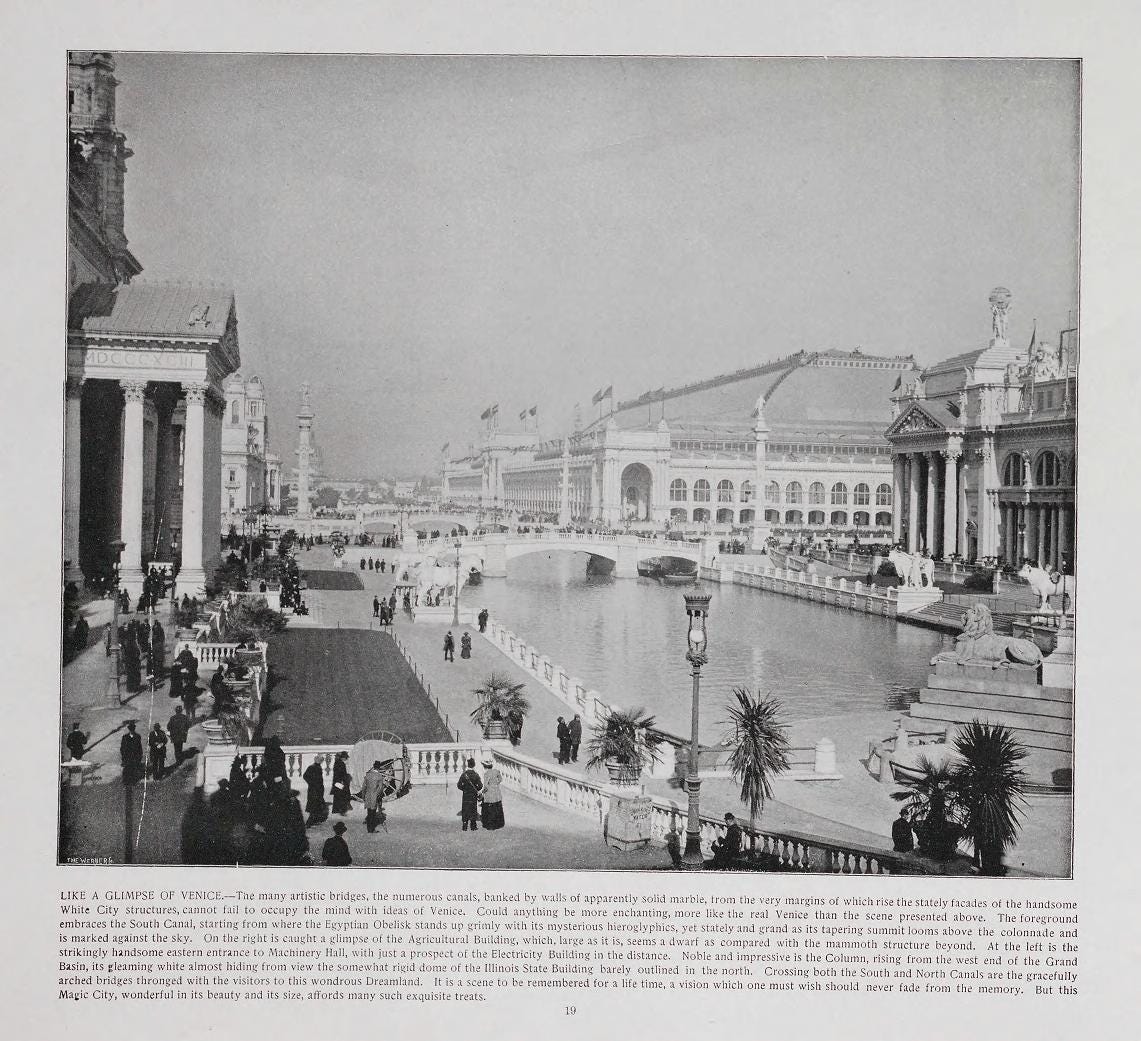
Even if you haven’t heard of the fair, you’ve probably sung about it—the line “Thine alabaster cities gleam” from “America the Beautiful” is a reference to the White City. To rival the Eiffel Tower, built for a world fair four years earlier, George Washington Gale Ferris Jr. built an enormous revolving wheel, with each of its thirty-six bus-sized cabins carrying forty occupants twenty-five stories into the air. Spain built replicas of the Nina, Pinta, and Santa Maria, sailed them across the Atlantic, and anchored them in the park’s lagoon. More than twenty-seven million people came to Chicago to see the fair.
One of them came looking for birds.
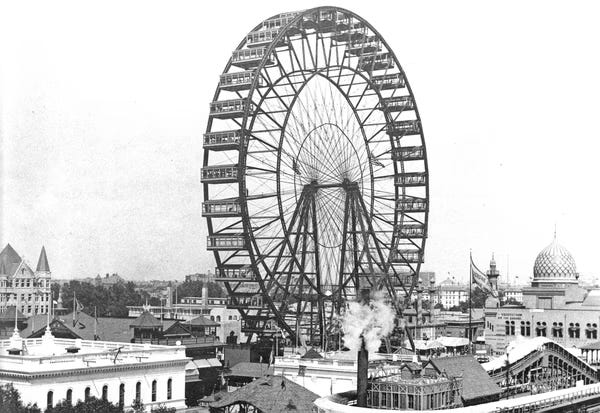 Ferris’s Wheel, towering above the fairgrounds.
Frank Chapman was no stranger to birding in unconventional settings. Seven years before, the budding ornithologist from Teaneck, New Jersey went on a now-famous birdwatching expedition in New York’s shopping district to publicize the ravages of the feather trade (https://birdhistory.substack.com/p/feathers-on-hats). Of the seven hundred hat-bearing women that passed him by, he counted five hundred forty-two adorned with the feathers, wings, or entire bodies of woodpeckers, sparrows, orioles, and owls.
Just as he’d seen in the streets of New York, women attending the Chicago fair sported hats with the latest fashions in feathers, but this time, these feathers weren’t much of interest to him. Nor was he much interested in commercial displays of feathers, like the eiderdown robes in the Norway delegation’s building. Now, as a twenty-nine year old staff ornithologist at New York’s American Museum of Natural History, he was looking for something more scientific.
Yet his search was anything but straightforward. While manufactures, agriculture, mining, electricity, and a dozen other special causes had their own dedicated buildings, there was none dedicated to wildlife. In his report to the American Ornithologists’ Union, he wrote that “two hundred and nine acres covered with exhibits proved as difficult ‘collecting ground’ as the mazes of a tropical forest, and afforded birds quite as excellent opportunities for concealment.” 1 (https://birdhistory.substack.com/p/the-ornithologist-in-the-white-city#footnote-1)
Bird History is a reader-supported publication. To receive new posts and support my work, consider becoming a free or paid subscriber.
Subscribe
As he combed the buildings housing forty-six international delegations, Chapman found small displays of native birds from Cuba, Guatemala, Japan, and Australia. He noticed a grouping of colorful mounted birds from the island of Trinidad, although some of them were “obviously from the mainland.” The best foreign exhibition of birds came from Costa Rica, which presented several hundred tropical birds in glass cases, each “bearing labels of the same character as those used by the Smithsonian Institution.”
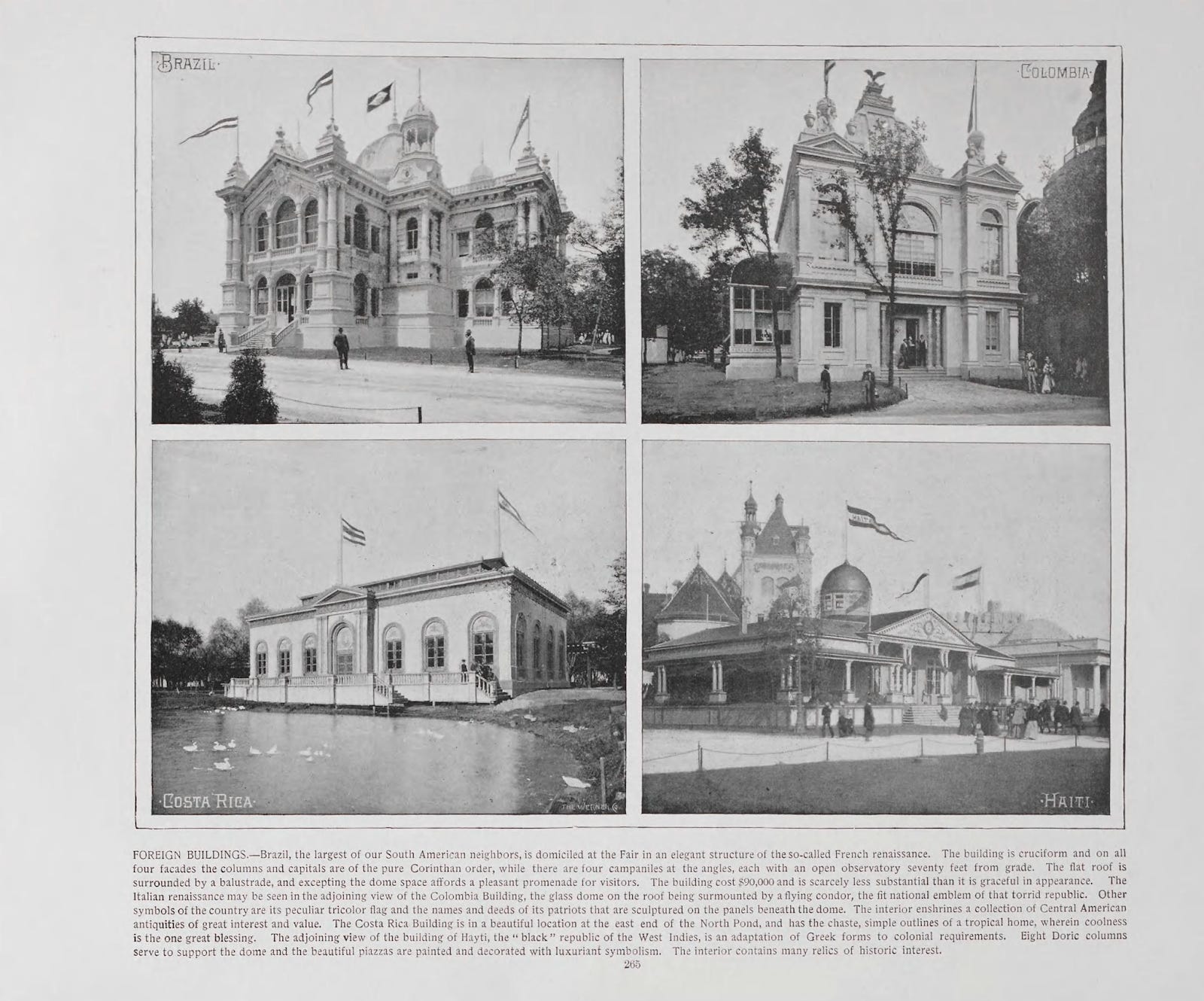 Several buildings for foreign delegations, purpose-built for the occasion. Clockwise from top left: Brazil, Colombia, Haiti, and Costa Rica.
Every U.S. state sent a delegation to the fair as well, and many of their buildings housed displays boasting of their native wildlife. Here Illinois reigned supreme, in no small part thanks to the ornithologist C. F. Adams, “whose death, due to overwork,” wrote Chapman, “occurred while he was arranging [the display] in Chicago.” The Illinois display featured dioramas with turkeys, herons, and crossbills in their natural surroundings, as well as cases presenting migrating birds, winter residents, summer residents, and “Stragglers in Illinois.” Chapman also found “a well-arranged collection of State birds” in the Ohio building, and mentioned collections of game birds displayed by North Carolina and Minnesota. He was less impressed by a display of common birds from Brown University “under the decidedly non-committal label of ‘Specimens of Birds either Beneficial or Injurious to the Farmer.”
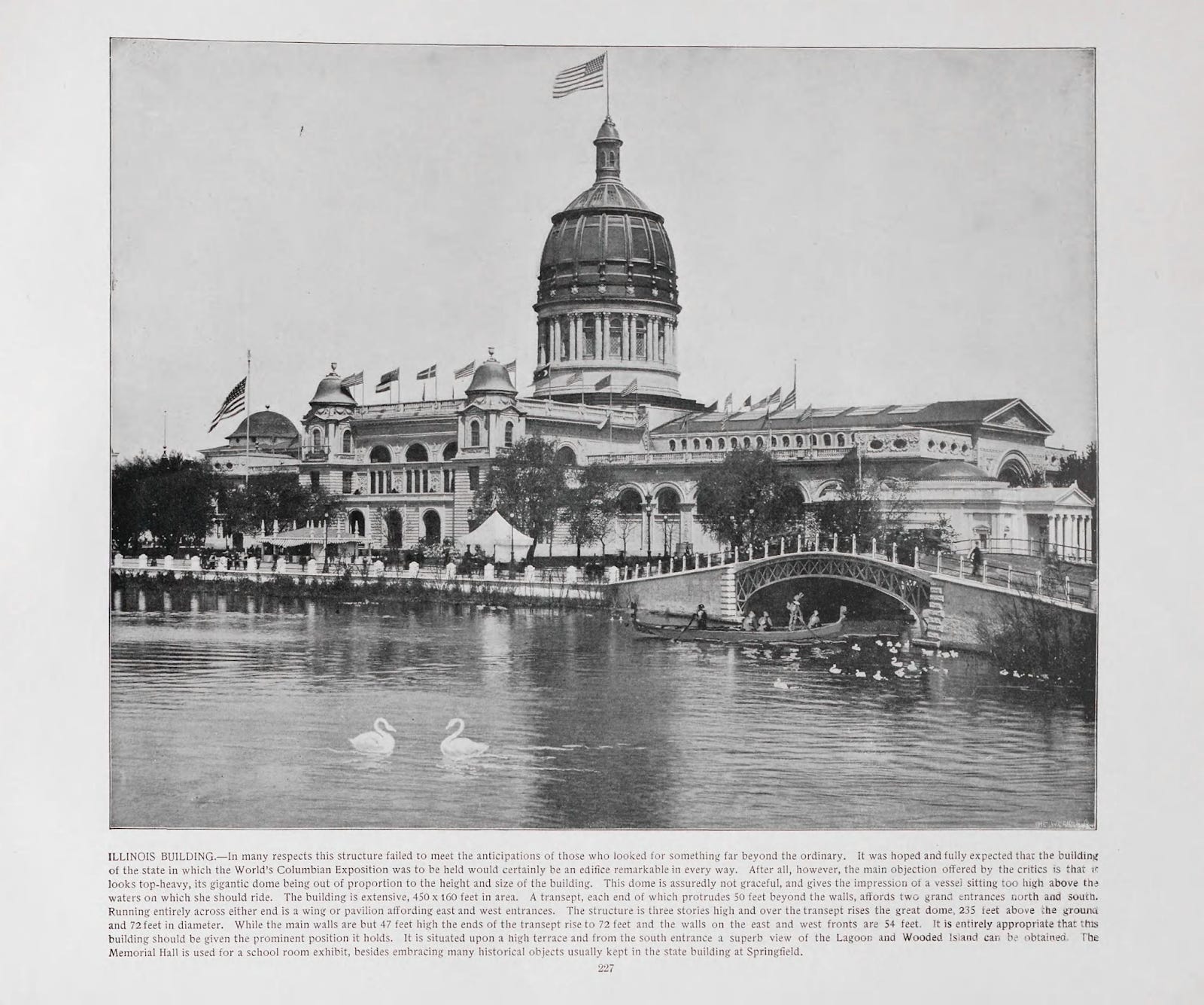 The Illinois Building.
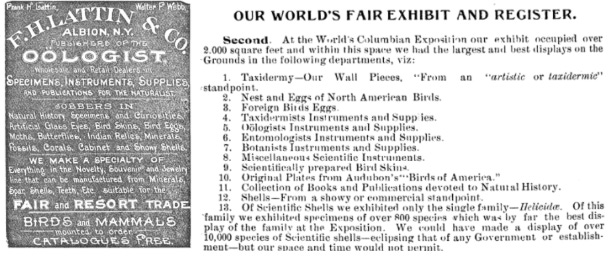
Plenty of professional taxidermists, both individuals and firms, came to the fair to show off their craft. The country’s preeminent supplier of museum and private collections, Ward’s Natural Science Establishment, had a large display in the fair’s Anthropology Building containing “representatives of almost every branch of the animal kingdom,” including several hundred birds. Among the taxidermists, Chapman judged the panel of game birds shown by F. H. Lattin & Co. to be the most impressive.
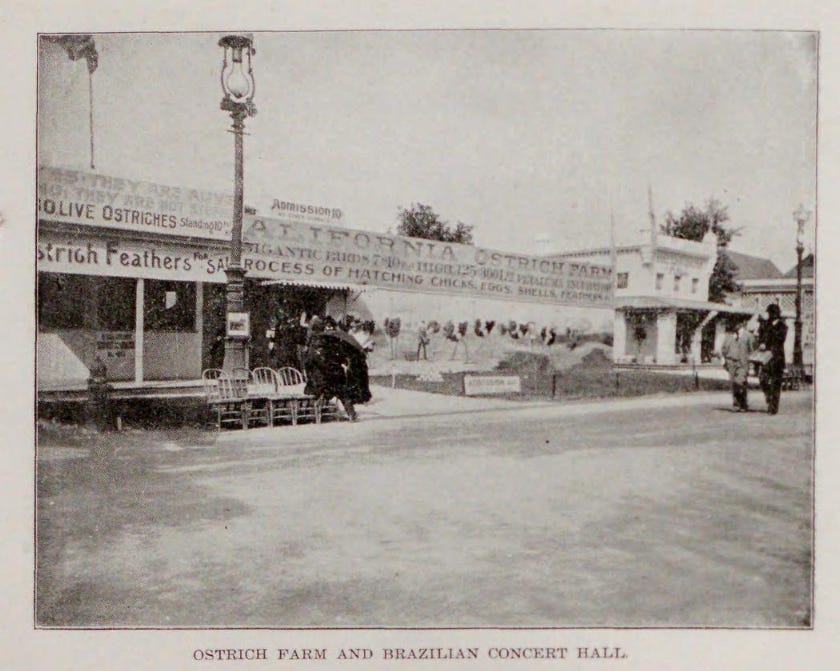
Like many of today’s birders, Chapman seemed to feel that captive and domesticated birds were beneath mentioning. But he undoubtedly saw a bunch of live birds too. Ostrich farming was booming in California, and the state advertised their novelty with a pen of ostriches and their chicks. Frederick Law Olmsted was in charge of the fair’s landscaping, and to add some living pops of color he ordered a whole flock of birds to occupy the fair’s central lagoon, including hundreds of ducks and geese, several thousand pigeons, a pair of flamingos and pelicans, four storks, and four snowy egrets. 2 (https://birdhistory.substack.com/p/the-ornithologist-in-the-white-city#footnote-2)
But it was in the U.S. Government building that Frank Chapman finally found what he was looking for. The Division of Economic Ornithology (https://birdhistory.substack.com/p/economic-ornithology), part of the Department of Agriculture, included a display which, he wrote, “as a graphic lesson in the relations of birds to man has probably never been equalled.” Chapman listed off the naturalistic displays illustrating the impact of birds on human affairs: “A Robin worm-hunting on a bit of lawn, attended by its ever-present persecutor, the House Sparrow; Cedarbirds feeding on elm beetles; House Sparrows destroying peach blossoms; Bobolinks in their summer dress, and also as Reed-birds in the rice-fields in the fall; Purple Grackles taking grubs from a lawn; Crows in a field of freshly sprouted corn; Kingbirds devouring bees, and Cuckoos feeding on tussock moths.” Visitors roaming the exhibit could pull open drawers to find bird skins arranged next to the insect, animal, and plant pests that had been found in their stomachs. And for those who wished to attract the services of these helpful birds, the exhibit included an array of birdhouses that might encourage birds to settle near the farm or garden.
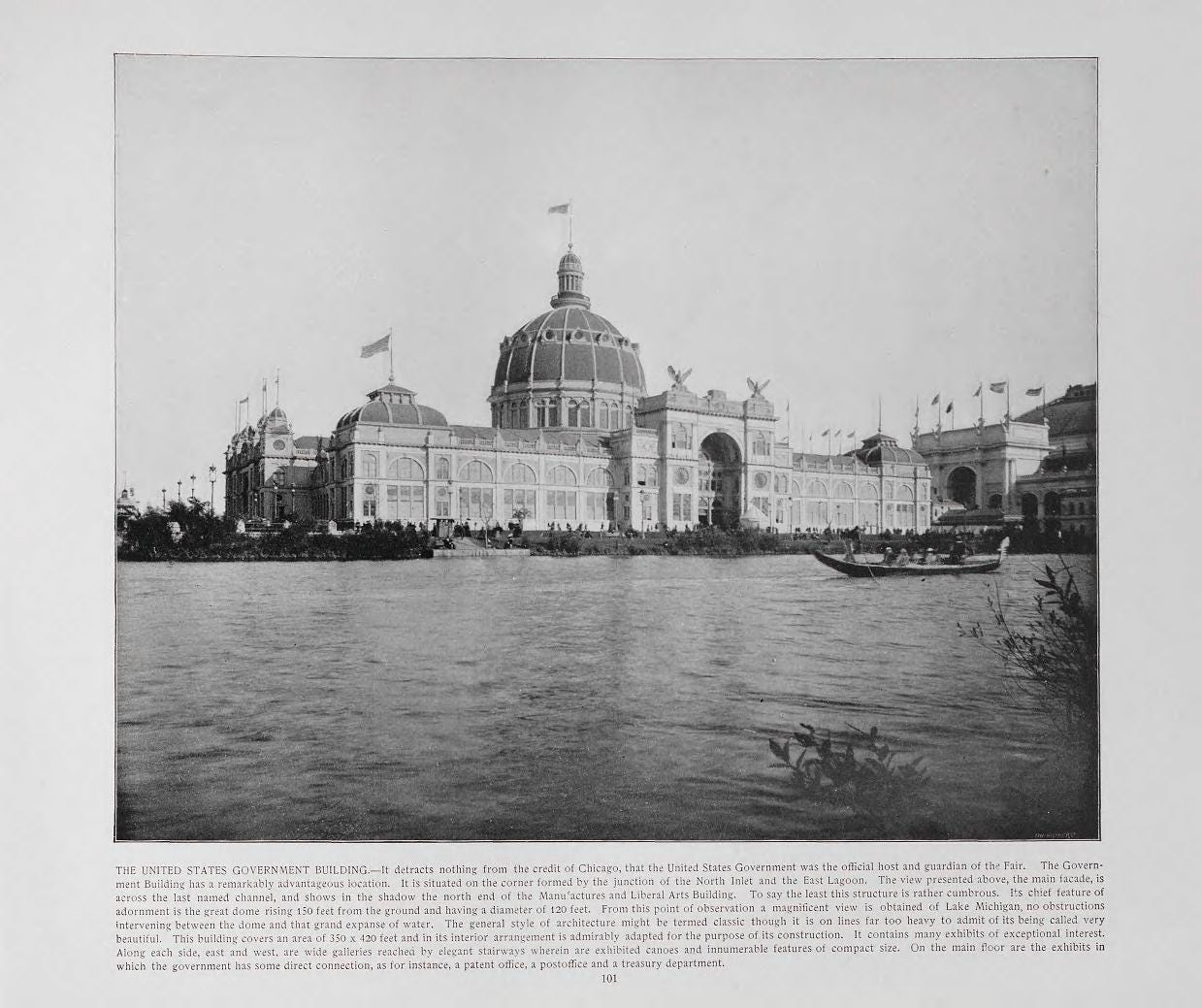 The United States Government Building.
The fair’s most extensive display of birds could be found across the Government Building’s grand rotunda at the Smithsonian Museum’s exhibit. One case contained dozens of “the principal game-birds of the world.” One held more than a hundred and fifty South American hummingbirds. Another had fifty birds of paradise. All along one wall, a crowded case held “a systematic collection of the leading representatives of the families of American birds.”
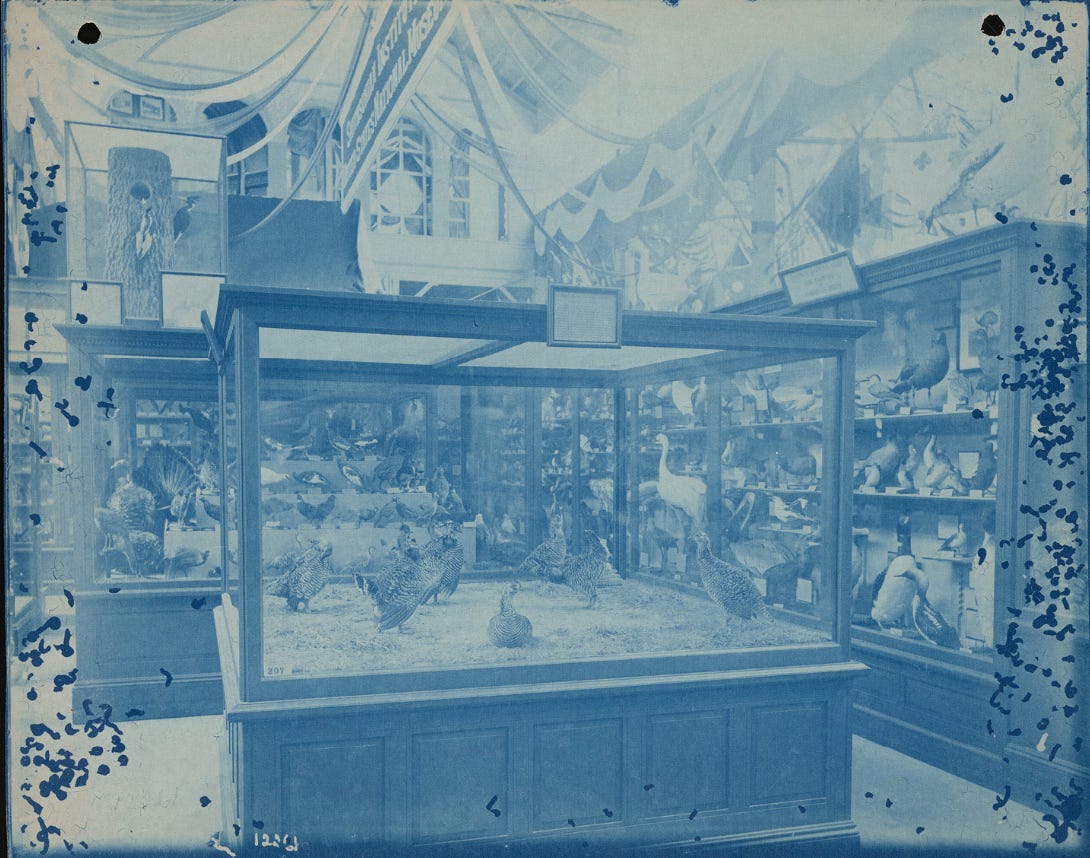 The photo quality here is not great but you can make out a pair of Ivory-billed Woodpeckers in the top left; below them, a case of game birds of the world (I could make out Wild Turkeys, Chukar, Bobwhites, and California Quail); prairie chickens in the case in the center; and in the cases along the right side a large array of birds, including terns, oystercatchers, loons, pelicans, and a Whooping Crane. These were all part of the Smithsonian’s exhibit. From the Smithsonian Archives (https://siarchives.si.edu/collections/siris_arc_401413).
The most instructive exhibit might have been a collection “illustrating the confusion caused by the application of the same popular name to different species of birds,” with a side-by-side comparison of pairs of birds from both sides of the Atlantic, each bearing the name robin (https://birdhistory.substack.com/p/how-robins-got-their-name), buzzard, quail, partridge, goldfinch, ortolan, redstart, woodcock, blackbird, oriole, sparrow hawk, yellowhammer, and turtle dove. A few cases showed birds frozen in scenes from real life, like a bowerbird arranging its elaborate nest (https://macaulaylibrary.org/asset/188495711) and a shrike impaling a mouse on a thorn (https://www.audubon.org/news/shrikes-have-absolutely-brutal-way-killing-large-prey). Finally, the Smithsonian gave fair-goers a chance to see mounted specimens of Carolina Parakeets (https://birdhistory.substack.com/p/we-used-to-have-parrots), Ivory-billed Woodpeckers, and Passenger Pigeons—birds that they would likely never again see in the wild.
•
As grand and successful as the World Columbian Exposition was, its ending was catastrophic. Two days before the fair’s closing ceremonies, Chicago’s mayor was assassinated. In the months after the fair closed, the tens of thousands of men it employed drifted back to a city with few jobs as the country reeled from the Panic of 1893. Only three of the fair’s buildings survived planned demolition, stripping for parts, and arson.
Yet the contributions of the fair to American life, both large and small, are not hard to find nearly a hundred and fifty years later. After seeing German chocolate-making machinery at the fair, Milton Hershey decided to switch from making candy to chocolates. Twenty-six-year-old Frank Lloyd Wright hated the fair’s neoclassical architecture, but the rest of the country disagreed—it helped inspire the City Beautiful movement, including the layout of the National Mall in Washington, D.C. The fair’s Midway, with its Ferris wheel and other attractions, inspired Coney Island and gave birth to the modern amusement park. Hawaiian performers introduced Americans to hula dancing. Syrian performers introduced Americans to belly dancing, and the ubiquitous “ Arabian Riff (https://en.wikipedia.org/wiki/Arabian_riff)” was composed at the fair to accompany them. The Pledge of Allegiance was likewise first performed at the fair. Americans got their first taste of Juicy Fruit gum, Quaker Oats, Vienna Sausage, moving sidewalks, and stretched penny souvenirs.
The birds, too, lived on. As the World Columbian Exposition was drawing to a close, the state of Illinois established the Columbian Museum of Chicago, later renamed the Field Museum of Natural History, to preserve artifacts and specimens that had been brought to the city by the fair. More than 50,000 objects from the exposition formed the foundation of the museum’s collections, including hundreds of taxidermied birds.
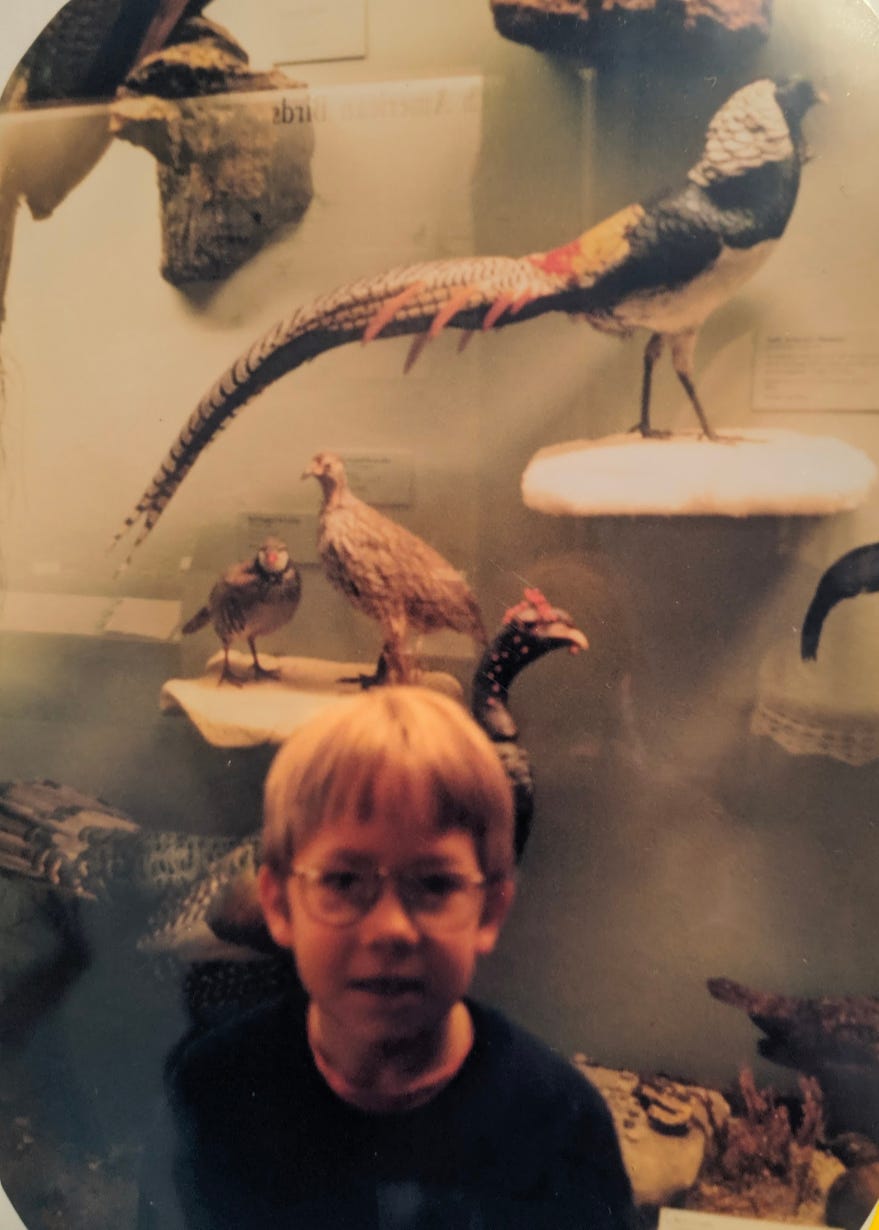 The author at the Field Museum around 1999. I was so taken with the Lady Amherst’s Pheasant (https://ebird.org/species/laaphe1) that I had my mom take a picture of me with it. Was the pheasant one of the birds from the fair? Maybe!!
1 (https://birdhistory.substack.com/p/the-ornithologist-in-the-white-city#footnote-anchor-1)
Chapman, Frank. “Ornithology at the World’s Fair.” The Auk, Vol. 10 no. 4, October 1893, p. 315.
2 (https://birdhistory.substack.com/p/the-ornithologist-in-the-white-city#footnote-anchor-2)
Larson, Erik. The Devil in the White City: Murder, Magic, and Madness at the Fair That Changed America. United Kingdom: Knopf Doubleday Publishing Group, 2004.
•
Subscribe to Bird History
By Robert Francis · Launched 3 years ago
Telling the stories of the birds of America - and the people who named them, ate them, studied them, and saved them.
Subscribe
By subscribing, you agree Substack's Terms of Use (https://substack.com/tos), and acknowledge its Information Collection Notice (https://substack.com/ccpa#personal-data-collected) and Privacy Policy (https://substack.com/privacy).

34 Likes∙
6 Restacks (https://substack.com/note/p-192925140/restacks?utm_source=substack&utm_content=facepile-restacks)
34
16
6
Share
PreviousNext
Discussion about this post
CommentsRestacks
User's avatar

Amy Stewart (https://substack.com/profile/1357643-amy-stewart?utm_source=substack-feed-item)
Apr 2 (https://birdhistory.substack.com/p/the-ornithologist-in-the-white-city/comment/237129481)
Liked by Robert Francis
This is so so good. There’s a tiny connection to the state bird story too—a lot of organizing for state flowers happened because of the fair, and state birds followed, organized largely by the same women.
Like (3)
Reply
Share
1 reply by Robert Francis (https://birdhistory.substack.com/p/the-ornithologist-in-the-white-city/comment/237129481)

jim wright (https://substack.com/profile/75466141-jim-wright?utm_source=substack-feed-item)
Apr 2 (https://birdhistory.substack.com/p/the-ornithologist-in-the-white-city/comment/237076966)
Liked by Robert Francis
Another terrific piece. Learned a lot. Thank you.
Like (3)
Reply
Share
1 reply by Robert Francis (https://birdhistory.substack.com/p/the-ornithologist-in-the-white-city/comment/237076966)
14 more comments... (https://birdhistory.substack.com/p/the-ornithologist-in-the-white-city/comments)
TopLatestDiscussions
The 100 Greatest Bird Names of All Time (https://birdhistory.substack.com/p/the-100-greatest-bird-names-of-all)
Making this list was the hardest thing I’ve ever done (https://birdhistory.substack.com/p/the-100-greatest-bird-names-of-all)
May 20•Robert Francis (https://substack.com/@birdhistory)
244
41
45
https://substackcdn.com/image/fetch/$s_!YAWX!,w_320,h_213,c_fill,f_auto,q_auto:good,fl_progressive:steep,g_center/https%3A%2F%2Fsubstack-post-media.s3.amazonaws.com%2Fpublic%2Fimages%2Fc0199eb1-f204-4a28-a3ad-b2ce15995cba_1015x502.png
How Robins Got Their Name (https://birdhistory.substack.com/p/how-robins-got-their-name)
Growing up in eastern South Dakota, winters were harsh, dark, and long, often lasting until deep into April. (https://birdhistory.substack.com/p/how-robins-got-their-name)
Aug 5, 2023•Robert Francis (https://substack.com/@birdhistory)
74
5
12
https://substackcdn.com/image/fetch/$s_!qZ_A!,w_320,h_213,c_fill,f_auto,q_auto:good,fl_progressive:steep,g_center/https%3A%2F%2Fsubstack-post-media.s3.amazonaws.com%2Fpublic%2Fimages%2Ff077236f-dda7-4851-99d6-aba18d70ffef_768x768.webp
Dining with Robins (https://birdhistory.substack.com/p/dining-with-robins)
Robins were a popular American dish for hundreds of years. What did it take to get them off the menu? (https://birdhistory.substack.com/p/dining-with-robins)
Dec 10, 2024•Robert Francis (https://substack.com/@birdhistory)
72
5
10
https://substackcdn.com/image/fetch/$s_!02f0!,w_320,h_213,c_fill,f_auto,q_auto:good,fl_progressive:steep,g_center/https%3A%2F%2Fsubstack-post-media.s3.amazonaws.com%2Fpublic%2Fimages%2Fcb2a1ba1-c141-4090-9252-75775ba89cc6_417x372.png
See all
Ready for more?
Subscribe